


Page 81 - EM3-26_LOW
P. 81
REPOR T


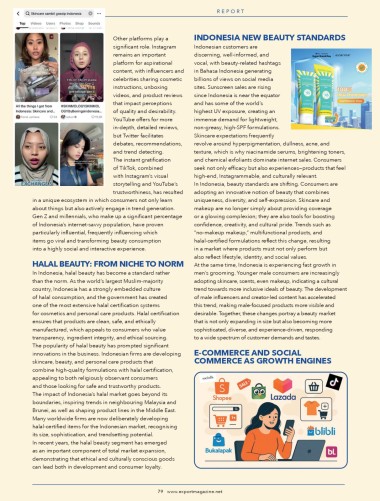
                                         Other platforms play a      INDONESIA NEW BEAUTY STANDARDS
                                         significant role. Instagram   Indonesian customers are
                                         remains an important        discerning, well-informed, and
                                         platform for aspirational   vocal, with beauty-related hashtags
                                         content, with influencers and   in Bahasa Indonesia generating
                                         celebrities sharing cosmetic   billions of views on social media
                                         instructions, unboxing      sites. Sunscreen sales are rising
                                         videos, and product reviews   since Indonesia is near the equator
                                         that impact perceptions     and has some of the world’s
                                         of quality and desirability.   highest UV exposure, creating an
                                         YouTube offers for more     immense demand for lightweight,
                                         in-depth, detailed reviews,   non-greasy, high-SPF formulations.
                                         but Twitter facilitates     Skincare expectations frequently
                                         debates, recommendations,   revolve around hyperpigmentation, dullness, acne, and
                                         and trend detecting.        texture, which is why niacinamide serums, brightening toners,
                                         The instant gratification   and chemical exfoliants dominate internet sales. Consumers
                                         of TikTok, combined         seek not only efficacy but also experiences—products that feel
                                         with Instagram’s visual     high-end, Instagrammable, and culturally relevant.
                                         storytelling and YouTube’s   In Indonesia, beauty standards are shifting. Consumers are
                                         trustworthiness, has resulted   adopting an innovative notion of beauty that combines
            in a unique ecosystem in which consumers not only learn   uniqueness, diversity, and self-expression. Skincare and
            about things but also actively engage in trend generation.   makeup are no longer simply about providing coverage
            Gen Z and millennials, who make up a significant percentage   or a glowing complexion; they are also tools for boosting
            of Indonesia’s internet-savvy population, have proven    confidence, creativity, and cultural pride. Trends such as
            particularly influential, frequently influencing which   “no-makeup makeup,” multifunctional products, and
            items go viral and transforming beauty consumption       halal-certified formulations reflect this change, resulting
            into a highly social and interactive experience.         in a market where products must not only perform but
                                                                     also reflect lifestyle, identity, and social values.
            HALAL BEAUTY: FROM NICHE TO NORM                         At the same time, Indonesia is experiencing fast growth in
            In Indonesia, halal beauty has become a standard rather   men’s grooming. Younger male consumers are increasingly
            than the norm. As the world’s largest Muslim-majority    adopting skincare, scents, even makeup, indicating a cultural
            country, Indonesia has a strongly embedded culture       trend towards more inclusive ideals of beauty. The development
            of halal consumption, and the government has created     of male influencers and creator-led content has accelerated
            one of the most extensive halal certification systems    this trend, making male-focused products more visible and
            for cosmetics and personal care products. Halal certification   desirable. Together, these changes portray a beauty market
            ensures that products are clean, safe, and ethically     that is not only expanding in size but also becoming more
            manufactured, which appeals to consumers who value       sophisticated, diverse, and experience-driven, responding
            transparency, ingredient integrity, and ethical sourcing.  to a wide spectrum of customer demands and tastes.
            The popularity of halal beauty has prompted significant
            innovations in the business. Indonesian firms are developing   E-COMMERCE AND SOCIAL
            skincare, beauty, and personal care products that        COMMERCE AS GROWTH ENGINES
            combine high-quality formulations with halal certification,
            appealing to both religiously observant consumers
            and those looking for safe and trustworthy products.
            The impact of Indonesia’s halal market goes beyond its
            boundaries, inspiring trends in neighbouring Malaysia and
            Brunei, as well as shaping product lines in the Middle East.
            Many worldwide firms are now deliberately developing
            halal-certified items for the Indonesian market, recognising
            its size, sophistication, and trendsetting potential.
            In recent years, the halal beauty segment has emerged
            as an important component of total market expansion,
            demonstrating that ethical and culturally conscious goods
            can lead both in development and consumer loyalty.


                                                        79   www.exportmagazine.net

