


Page 158 - EM - EXPORT MAGAZINE PERFUMERY EDITION
P. 158
R R  E E  P P  O O   R R  T T


          Boutiqaat: Influencer-Driven
          Beauty Platform
          Kuwait-based Boutiqaat has pioneered
          an  innovative  approach   to   beauty
          e-commerce   built   around   influencer
          curation. The platform allows users to shop
          virtual “boutiques” curated by popular
          social media personalities from across the
          region,  creating  a  discovery  experience
          that  leverages  the  strong  influence  of
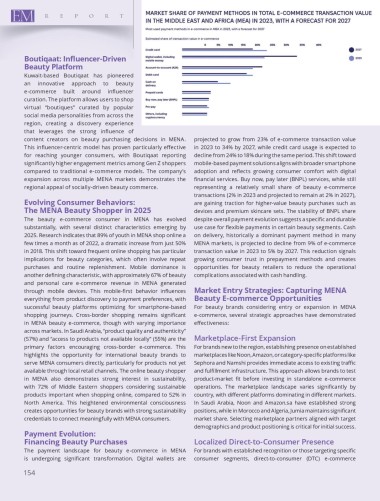
          content creators on  beauty purchasing  decisions in  MENA.   projected to grow from 23% of e-commerce transaction value
          This influencer-centric model has proven particularly effective   in 2023 to 34% by 2027, while credit card usage is expected to
          for  reaching  younger  consumers,  with  Boutiqaat  reporting   decline from 24% to 18% during the same period. This shift toward
          significantly higher engagement metrics among Gen Z shoppers   mobile-based payment solutions aligns with broader smartphone
          compared to traditional e-commerce models. The company’s   adoption  and  reflects  growing  consumer  comfort  with  digital
          expansion across multiple MENA markets demonstrates the    financial services. Buy now, pay later (BNPL) services, while still
          regional appeal of socially-driven beauty commerce.        representing a  relatively  small share  of beauty e-commerce
                                                                     transactions (2% in 2023 and projected to remain at 2% in 2027),
          Evolving Consumer Behaviors:                               are gaining traction for higher-value beauty purchases such as
          The MENA Beauty Shopper in 2025                            devices and premium skincare sets. The stability of BNPL share
          The  beauty  e-commerce  consumer  in  MENA  has  evolved   despite overall payment evolution suggests a specific and durable
          substantially, with several distinct characteristics emerging by   use case for flexible payments in certain beauty segments. Cash
          2025. Research indicates that 89% of youth in MENA shop online a   on delivery, historically a dominant payment method in many
          few times a month as of 2022, a dramatic increase from just 50%   MENA markets, is projected to decline from 9% of e-commerce
          in 2018. This shift toward frequent online shopping has particular   transaction value in 2023 to 5% by 2027. This reduction signals
          implications for beauty categories, which often involve repeat   growing consumer trust in prepayment methods and creates
          purchases and routine replenishment. Mobile  dominance is   opportunities for beauty retailers to reduce the operational
          another defining characteristic, with approximately 67% of beauty   complications associated with cash handling.
          and personal care e-commerce revenue in MENA generated
          through  mobile  devices.  This  mobile-first  behavior  influences  Market Entry Strategies: Capturing MENA
          everything from product discovery to payment preferences, with  Beauty E-commerce Opportunities
          successful beauty platforms optimizing for smartphone-based   For  beauty  brands  considering  entry  or  expansion  in  MENA
          shopping  journeys.  Cross-border  shopping  remains  significant   e-commerce, several strategic approaches have demonstrated
          in MENA beauty e-commerce, though with varying importance   effectiveness:
          across markets. In Saudi Arabia, “product quality and authenticity”
          (57%) and “access to products not available locally” (55%) are the  Marketplace-First Expansion
          primary factors encouraging cross-border e-commerce. This   For brands new to the region, establishing presence on established
          highlights  the  opportunity  for  international  beauty  brands  to   marketplaces like Noon, Amazon, or category-specific platforms like
          serve MENA consumers directly, particularly for products not yet   Sephora and Namshi provides immediate access to existing traffic
          available through local retail channels. The online beauty shopper   and fulfillment infrastructure. This approach allows brands to test
          in MENA also demonstrates strong interest in sustainability,   product-market  fit  before  investing  in  standalone  e-commerce
          with 72% of Middle Eastern shoppers considering sustainable   operations.  The  marketplace  landscape  varies  significantly  by
          products important when shopping online, compared to 52% in   country, with different platforms dominating in different markets.
          North  America.  This  heightened  environmental  consciousness   In Saudi Arabia, Noon and Amazon.sa have established strong
          creates opportunities for beauty brands with strong sustainability   positions, while in Morocco and Algeria, Jumia maintains significant
          credentials to connect meaningfully with MENA consumers.   market share. Selecting marketplace partners aligned with target
                                                                     demographics and product positioning is critical for initial success.
          Payment Evolution:
          Financing Beauty Purchases                                 Localized Direct-to-Consumer Presence
          The payment landscape for beauty e-commerce in MENA        For brands with established recognition or those targeting specific
          is  undergoing  significant  transformation.  Digital  wallets  are   consumer segments, direct-to-consumer (DTC) e-commerce

         154
         154

