


Page 57 - EM - EXPORT MAGAZINE PERFUMERY EDITION
P. 57
R R  E E  P P   O O  R R  T T


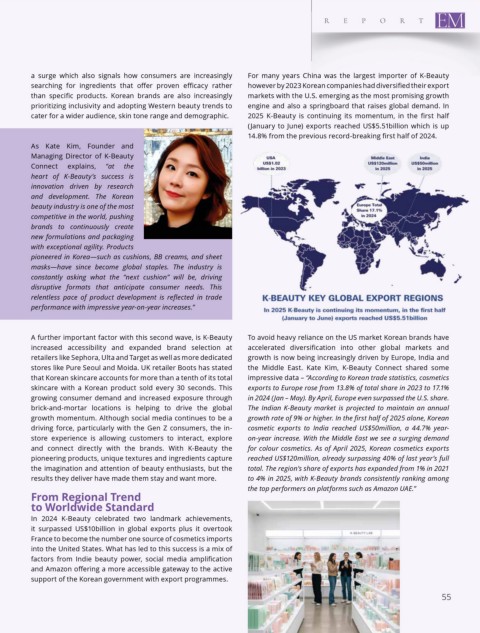
          a surge which also signals how  consumers are increasingly   For many years China was the largest importer of  K-Beauty
          searching  for  ingredients  that  offer  proven  efficacy  rather   however by 2023 Korean companies had diversified their export
          than  specific  products.  Korean  brands  are  also  increasingly   markets with the U.S. emerging as the most promising growth
          prioritizing inclusivity and adopting Western beauty trends to   engine and also a springboard that raises global demand. In
          cater for a wider audience, skin tone range and demographic.   2025  K-Beauty  is  continuing  its  momentum,  in  the  first  half
                                                                      (January to June) exports reached US$5.51billion which is up
                                                                      14.8% from the previous record-breaking first half of 2024.
          As  Kate  Kim,  Founder and
          Managing Director of K-Beauty
          Connect   explains,  “at  the
          heart  of  K-Beauty’s  success  is
          innovation  driven  by  research
          and  development.  The  Korean
          beauty industry is one of the most
          competitive in the world, pushing
          brands  to  continuously  create
          new formulations and packaging
          with exceptional agility. Products
          pioneered in Korea—such as cushions, BB creams, and sheet
          masks—have  since  become  global  staples.  The  industry  is
          constantly  asking  what  the  “next  cushion”  will  be,  driving
          disruptive  formats  that  anticipate  consumer  needs.  This
          relentless  pace  of  product  development  is  reflected  in  trade
          performance with impressive year-on-year increases.”


          A further important factor with this second wave, is K-Beauty   To avoid heavy reliance on the US market Korean brands have
          increased  accessibility  and  expanded  brand  selection  at   accelerated  diversification  into  other  global  markets  and
          retailers like Sephora, Ulta and Target as well as more dedicated   growth is now being increasingly driven by Europe, India and
          stores like Pure Seoul and Moida. UK retailer Boots has stated   the Middle East. Kate Kim, K-Beauty Connect shared  some
          that Korean skincare accounts for more than a tenth of its total   impressive data – “According to Korean trade statistics, cosmetics
          skincare  with  a Korean  product  sold  every  30  seconds. This   exports to Europe rose from 13.8% of total share in 2023 to 17.1%
          growing consumer demand and increased exposure through      in 2024 (Jan – May). By April, Europe even surpassed the U.S. share.
          brick-and-mortar locations is helping to drive the global   The Indian K-Beauty market is projected to maintain an annual
          growth momentum. Although social media continues to be a    growth rate of 9% or higher. In the first half of 2025 alone, Korean
          driving  force,  particularly  with  the  Gen  Z  consumers,  the  in-  cosmetic  exports  to  India  reached  US$50million,  a  44.7%  year-
          store experience is allowing customers to interact, explore   on-year increase. With the Middle East we see a surging demand
          and  connect directly  with  the  brands. With  K-Beauty  the   for colour cosmetics. As of April 2025, Korean cosmetics exports
          pioneering products, unique textures and ingredients capture   reached US$120million, already surpassing 40% of last year’s full
          the imagination and attention of beauty enthusiasts, but the   total. The region’s share of exports has expanded from 1% in 2021
          results they deliver have made them stay and want more.     to 4% in 2025, with K-Beauty brands consistently ranking among
                                                                      the top performers on platforms such as Amazon UAE.”
          From Regional Trend
          to Worldwide Standard
          In 2024 K-Beauty celebrated two landmark achievements,
          it surpassed US$10billion in global exports plus it overtook
          France to become the number one source of cosmetics imports
          into the United States. What has led to this success is a mix of
          factors  from  Indie  beauty  power,  social  media  amplification
          and Amazon offering a more accessible gateway to the active
          support of the Korean government with export programmes.

                                                                                                                            55
                                                                                                                            55

